




The three defining website design trends for 2026 are purposeful motion and animation, universal accessibility as a standard, and digital sustainability.
Together, these trends create websites that prioritise high-performance and inclusive user experiences over aesthetic features. This creates websites that are faster for visitors, easier to navigate for everyone, and more understandable to AI search engines.
A recent Elementor article, the leading website builder platform for professionals and business owners on WordPress, shared some of the trends set to take over website design this year. Here are three trends worth understanding for 2026, with tips on how to implement them.

Trend 1: How does animation improve the user experience of a website design?
Purposeful motion guides attention. It doesn’t distract from it.
Using animation in 2026 design focuses on strategic movement that improves the speed and user experience. It’s about using movement strategically to guide visitors through their buying process, or discovery of the brand. This could be:
- Subtle animations that draw the eye to a call-to-action
- A smooth scroll that helps visitors understand how content is structured
- Hover effects indicating a link, button, or image is clickable
Motion that serves a purpose.
Visitors stay longer on sites that feel intuitive, finding what they need faster. And when animations are subtle and intentional, it improves accessibility for visitors with motion sensitivity because they’re not overwhelmed.
The psychology behind animation is simple, showing that people follow movement.
Using animation the right way
When using the right animations intentionally, visitors are essentially guided through a journey. That could mean a smooth transition between sections that shows how content connects, or an animation that appears only when relevant, drawing attention to what matters most.
The key thing to remember is every effect or animation should have a reason.
For AI search engines, purposeful motion signals that a website has been thoughtfully designed. It’s easier for AI bots to crawl sites with clear visual hierarchy and effective navigation, and this works toward better visibility in AI-powered search results like Google’s AI Overview.
How should I add animations to my website design?
To get started, try adding small hover effects such as a colour change to calls to action or add fade animations on information to grab the audience’s attention. Each thought out movement will help improve user experience.

Trend 2: Why is accessibility the more recognised standard for 2026?
Because accessible websites work better for everyone.
Accessibility is fundamental to good web design. Features such as proper heading structure, alt text for images, readable colour contrasts and keyboard navigation aren’t just helpful for visitors with additional needs. This website design trend makes websites better for everyone.
According to research from The House of Commons Library, around 1 in 4 adults in the UK experience some form of disability. That means a significant number of those using the internet in the UK will benefit from websites using the right accessibility measures online.
But the benefits extend far beyond that.
Visitors using a website on a phone in bright sunlight? Better colour contrast helps. Visitors with a slow internet connection? Proper heading structure means they can navigate without waiting for images to load. Individuals learning English as a second language? Clear, simple language and logical structure help them understand faster.
When accessibility is built into a website design from the start, it naturally creates better user experiences for all visitors.
- Buttons are easier to click
- Text is easier to read
- Navigation is clearer
- Forms are simpler and quicker to complete
Improvements like these can help anyone find what they need quickly, which is extremely valuable to how they perceive a brand going forward. This approach also improves AI search visibility.

Why will website accessibility help my visibility in AI search and Google?
AI engines and search bots prioritise well-structured, accessible sites because they’re easier to understand. When a website follows accessibility standards, specifically those set by the Web Content Accessibility Guidelines (WCAG), AI search engines can understand content better.
Content that’s optimised using Generative Experience Optimisation (GEO), uses accessibility as a standard, making it easier to understand and more likely to appear in AI Overview and conversational search results.
Accessibility and SEO are interconnected. A website that’s built to be accessible is automatically built to be understood by AI.
How can I make my website accessible for visitors and AI search?
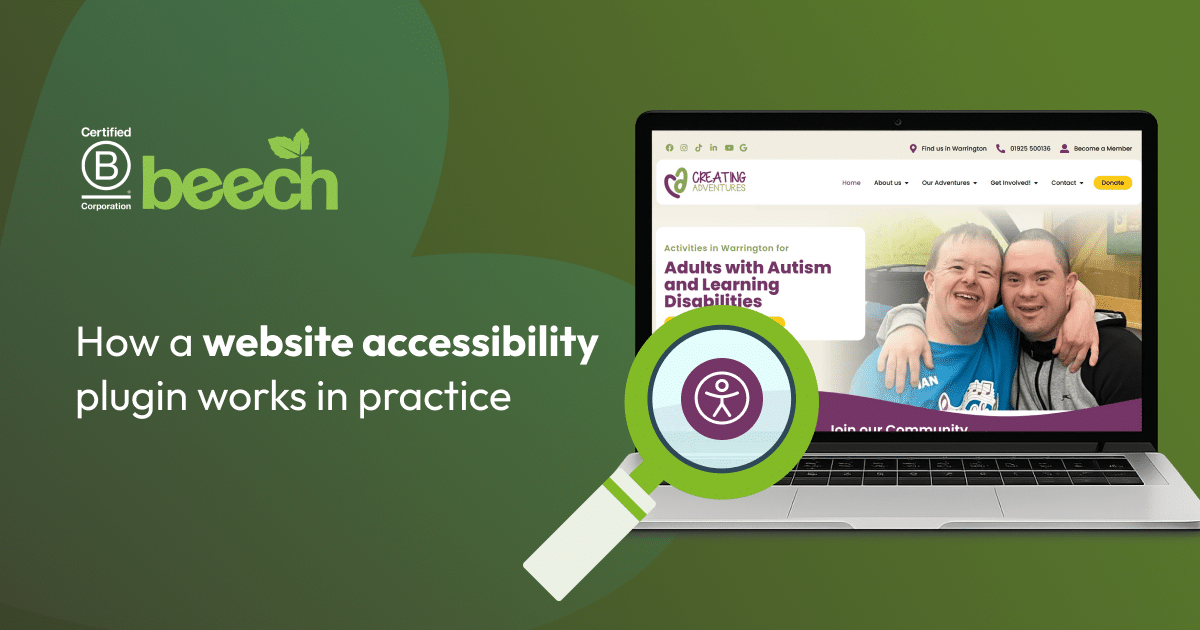
An effective method of improving accessibility while maintaining your existing design is through an accessibility plugin. This feature enables visitors to customise their experience, changing design elements from the size of the text and headings to the colouring of the entire page. Check out one we’ve added to the Creating Adventures website, a charity Beech is proud to sponsor.
For more insight into making a website more accessible, read this previous blog post on website design.

Trend 3: What is sustainable website design?
Sustainable design means faster websites, the opportunity for better search rankings, and a lower carbon footprint.
Website sustainability is becoming increasingly important to values-driven organisations. It’s an ethical choice, but it can also be quite a strategic choice for organisations looking to improve online performance and connect with customers prioritising their values.
Lightweight code, optimised images, efficient, eco-friendly hosting powered by renewable energy. These are practices that reduce the energy a website consumes with every page view, improving overall digital emissions.
According to Wholegrain Digital, creators of the Website Carbon Calculator, globally, the average web page produces approximately 0.36 grams of CO2 equivalent per pageview. For a website with 10,000 monthly page views, that’s 43 kg CO2e per year, which is equivalent to approximately charging a smartphone over 5,000 times!
So not only does sustainable website design reduce an organisation’s digital footprint and overall emissions, it also directly impacts online business success.
Lighter websites load faster, and faster websites rank better in Google, (a confirmed ranking factor). Even better, faster websites are more likely to convert customers!
Data from Cloudflare shows that 47% of customers expect a webpage to load in 2 seconds or less. In fact, the conversion rate of a page loading in 2.4 seconds is 1.9%, compared to a website taking 4.2 seconds to load, where conversion rate drops below 1%.
As a B Corp certified agency, sustainability is built into how we work, with the mission to help more businesses create positive impact alongside profit. That means every website built is optimised for performance and efficiency.

How does website sustainability help with AI search visibility?
Sustainable web design is important because search engines and AI systems are rewarding it, leading to better rankings in 2026. Additionally, customers increasingly expect it. A 2025 study found that 62% of consumers prefer brands that demonstrate environmental responsibility. A sustainable website design can communicate that commitment.
As well as this, streamlining code and scripts to reduce website carbon weight, will also improve the clarity for AI systems interpreting content. It makes a website more easily scannable, which helps towards being visible through the likes of AI Overview.
How easy is it to make a website sustainable?
There are various methods to making a website more sustainable, with some more technical than others. Watch this video from our YouTube channel to find out more. Alternatively, check out this blog post, breaking down what sustainable website development means for businesses.
One action you can take today is to review your WordPress plugin list. Identify plugins that are inactive or no longer serving your site, and remove them to streamline performance.
What do these 2026 website trends mean for an existing website?
One thing to note about these three trends in particular is that they aren’t separate from each other, they work together.
When combining these elements, they create websites that are fast, inclusive, and visible in various types of search result. Animations guide visitors without slowing performance. Accessibility makes the site work for everyone. Sustainability improves speed and reduces environmental impact.
What works now is different from what worked three years ago, or even last year. And as website design continues to evolve and adapt to new technology, it’s important to consider the benefits of implementing new design features and optimising what’s already there.
Not everything has to be a complete reset, and sometimes all it takes are strategic updates to make a real difference.
Are you wondering what type of changes your website needs?
These trends are shaping website design in 2026. If you’re thinking about how they apply to your website, let’s chat about what’s next.