




If you’ve ever asked the question, “Is our social media strategy producing the results and sales we need?” You’re not alone.
For many, the answer is often difficult to measure, especially when we compare results alongside the effort put into activities like social media posting, engagement and overall strategy. Why is it so difficult to measure?
The complexity is due to both platform and behavioural change. Feeds are more competitive than they were two years ago, people are more selective about what they’re interested in, and their attention is harder to earn. Which means the results we used to look for might not be present in the same way.
A social media strategy built around sharing lots of content, posting frequently and hoping something lands, is returning less than it once did. But the organisations building around intent and consistency are seeing something different.
Adapting a social media strategy for less quantity and more quality doesn’t require a complete overhaul. It requires clarity about what social media is useful for in a business setting, and the discipline to build around that idea.
Follow the advice below to understand what an effective social media strategy looks like in 2026, and some key elements to help build one that works for your business.
What does social media actually do for a business?
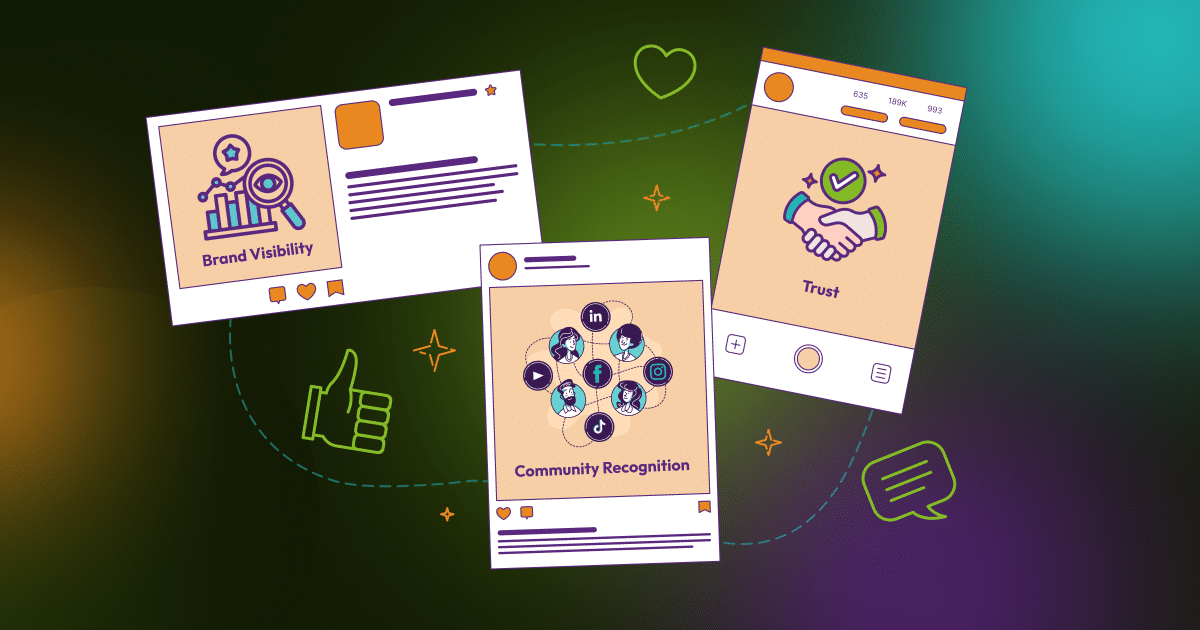
Social media does several things well. Understanding which of them matters most to businesses is key to building a successful strategy.
Brand visibility is the most immediate
Regular, consistent content keeps an organisation present in the minds of its customers, building the kind of familiarity that sits underneath purchasing decisions without always appearing in a conversion report.
Trust develops through repeated exposure to credible, useful content. Community recognition follows from showing up in the same spaces as the right people over an extended period.
Google’s research into the ‘Messy Middle’ customer journey shows the non-linear way people research and make purchasing decisions. The research found that buyers cycle repeatedly between exploring options and evaluating them before they ever commit. That process takes time, and the brands present throughout the journey are the ones most likely to be chosen at the end.
Social media is connected to AI search
The reach of social media content has also expanded considerably, as search engines and AI tools now index and cite social media content alongside traditional web pages.
Research from Peec AI and Semrush, analysing tens of millions of AI citations, found that LinkedIn, Reddit, and YouTube consistently appear among the most-cited domains across AI platforms. A post published today has the potential to be surfaced by Google or cited directly in an AI-generated response months after it was written.
We explored this in detail in a recent post on social media SEO and the change to AI search.
This change raises the value of content that is specific, useful, and demonstrates expertise. AI systems favour sources that post consistently and with depth, covering topics in a way that gives them something worth citing.
Businesses gaining visibility through AI search are producing content with longevity, not just posts optimised purely for immediate engagement.
Defined goals still matter, including:
- Growing recognition within a target sector
- Inbound contact from customers who cite a specific post
- Increased profile visits from decision-makers at named accounts.
Selecting the right KPI to measure depends on the business, and defining it up front shapes everything that follows.
Why is consistency more important than going viral in a B2B social media strategy?
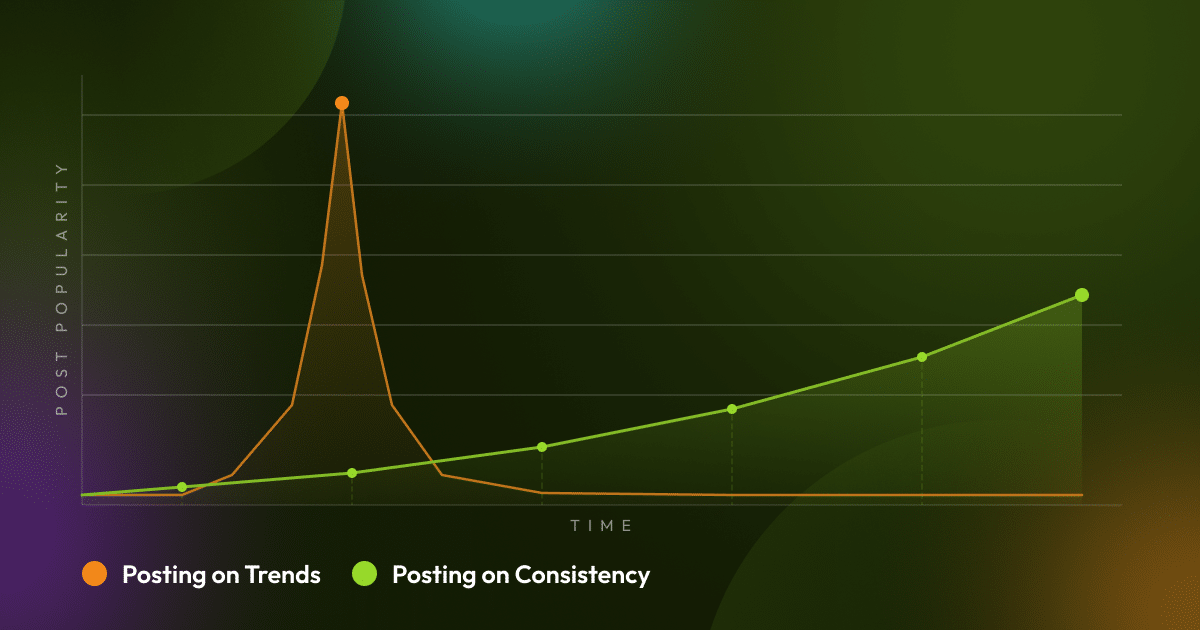
One post going viral sounds like the ideal outcome, and it is easy to understand why. The idea of reaching thousands of new people overnight, gaining instant recognition, and feeling like the business has finally broken through is always appealing.
In reality, though, it rarely produces anything sustainable for a brand looking to grow. A spike in impressions from an audience that was never the right fit generates great attention that may not directly result in leads or sales and can even water down existing efforts.
Consistency, and showing up regularly with content that is relevant, specific, and credible to a defined customer base builds familiarity over time. That familiarity builds trust.
According to LinkedIn’s B2B Marketing Benchmark 2025, 94% of B2B marketers now say trust is the key to marketing success. That trust is not built in a single post. It grows over weeks and months of recognisable, useful presence.
LinkedIn data supports this, with the pages publishing weekly valuable content seeing twice the engagement of those posting less frequently. They’re also growing their following quicker, because the algorithm (see Glossary below for definition) rewards sustained, relevant activity over sporadic bursts.
So, consistency is key, and a realistic, sustainable publishing rhythm will outperform an ambitious schedule that runs well for three weeks and then collapses.
Which platforms belong in a B2B strategy in 2026?

Platform choice is a strategic decision, and it starts with one question, “Where do our ideal customers actually spend time, and what kind of content are they looking for?”
Posting everywhere can produce a less intentional, and more diluted effort, which makes choosing the right platforms is a crucial foundation for any social media strategy.
For service-based businesses with a strong local or community dimension, Facebook remains a great choice, particularly for reaching established audiences and running targeted activity within defined geographic areas.
Product-led or visually driven businesses will find Instagram well suited to showcasing what they offer, with the added benefit that content is now indexed by Google and eligible to appear in search results.
For businesses producing video content, YouTube brings search benefits as well as social reach, and as a Google-owned platform it integrates directly with Google Search.
The starting point is always audience, and the platform follows from that.
LinkedIn, the top choice for B2B businesses
For most B2B organisations, LinkedIn is the clearest option for their social media efforts. Research consistently shows it generates between 75% and 85% of all B2B leads produced through social media.
According to the Content Marketing Institute, LinkedIn is the channel that B2B marketers rate it as the most effective channel for thought leadership. That combination of audience quality and content credibility is difficult to replicate elsewhere.
How to choose the right platforms for a social media strategy
On every social media platform, the priority should always be the audience of potential customers looking at content and profiles.
Businesses must have clarity on key characteristics of their audience before creating anything targeted. This means:
- Decision-makers in defined sectors
- Organisations of a specific scale
- People facing a particular business challenge.
Content speaks to that audience directly, rather than attempting broad appeal, will be more effective at driving the right people to a business.
Format matters considerably too. Long-form posts sharing an authentic professional perspective will outperform promotional content, as customers feel more connected to what’s being shared. This could include:
- Commentary on industry challenges
- Observations from project experiences
- Unique perspectives that take a clear position on industry news.
These all perform well because they give the audience something worth engaging with.
Should I be posting on a personal profile or business page?
Personal profiles from founders and senior team members tend to reach further than company pages on most platforms.
On LinkedIn specifically, posts from individual profiles often receive more engagement than equivalent content from a company page. A strategy that takes advantage of both, with team members sharing company content alongside their own perspectives, extends reach without requiring additional content to be produced.
There isn’t a one-size-fits-all for the right platforms to use in a social media strategy. The starting point is always audience, and the platform follows from that.
How does AI fit into a responsible social media strategy?

The question worth asking about AI in social media content is not if we should use it, because most teams already are. It’s about how we use it that matters.
AI can assist with content creation, video editing and even creating images and videos from scratch. But there is a downside to businesses across the world having such instant access to Generative AI tools like Gemini, Midjourney, Claude and more.
Feeds are now filling with content that is grammatically sound, structurally competent, and entirely generic.
Research from Digiday found that only 26% of consumers prefer generative AI creator content to traditional creator content, down from 60% in 2023. While, the efficiency of AI generated content is great for many, it’s looking to be more of a risk for some brands, especially when customers don’t want it.
The customer should be the centre to everything, including how we create content.
Our recommendation for using AI in a social media strategy
Use AI to assist in marketing activities, not create it from scratch. There are many ways these tools can be beneficial, including:
- Generating ideas
- Reviewing initial drafts
- Suggesting unique approaches to an article or blog post
- Performing research into topics (though always have a human check the results!)
But the best part of social media for many people who use it is the social part. ‘People buy from people’ is a common phrase across marketing, but it’s very true. Authenticity and using these tools in a way that’s responsible and ethical is essential to success.
For more ways to integrate AI into your marketing, read this previous article where we take a deeper look.
What does social media strategy look like when it connects to the wider marketing picture?
A social media strategy that’s isolated from the rest of a business plan tends to be less successful than one that’s fully integrated into how a business operates.
When social media plans are integrated with search, email, and direct outreach, it becomes a different kind of asset entirely.
- A blog post may provide the source material for several weeks of social content
- An email campaign drives traffic to a recent piece of thought leadership
- A social media post can highlight a case study that a potential lead shares with a decision-maker elsewhere in their organisation
Each channel reinforces the others, and those efforts become part of one combined approach to reach customers and make sales.
A social media strategy that sits within a coherent wider approach can also change how businesses measure performance. Organisations gain a clearer picture of which audiences’ social media is reaching, which content is building recognition with the right people, and where it is contributing to conversations that eventually become enquiries.
That mindset change will also produce a more aligned plan for the future.
How do you cut through the noise on social media?
Cutting through in 2026 means producing less content with more purpose. It means:
- Choosing platforms based on where the right audience is, instead of where it feels safest to post.
- Writing content with enough depth and specificity that AI tools find the content worth citing
- Integrating employees and people in the business into personal profile content, as well as the company page
- Connecting social media to the wider marketing picture so that every post does more than one job.
Competitors still optimising for volume are producing more content for less returns. A strategy built around consistency, credibility, and integration will outperform that approach over any meaningful timeframe.
That is how the noise gets cut through. Not by being louder, but by being more useful, more consistently, to exactly the right people.
If you are thinking about how social media fits into a wider marketing strategy, we would be happy to explore that. Let’s chat about what’s next.
Keyword Glossary
For more guidance on the terms and phrases used throughout this post, read through our glossary below.
Algorithm – The system a social media platform uses to decide which content appears in which user’s feed, and how prominently. Algorithms in 2026 reward relevance and consistency over sporadic bursts of activity.
AI citation – When an AI search tool references a specific piece of content in its response. Research found that LinkedIn, Reddit, and YouTube are among the most-cited domains across AI platforms, favouring content that is specific, useful, and demonstrates consistent expertise.
AI search – Tools such as ChatGPT, Perplexity, and Google’s AI Mode that generate direct answers by drawing on indexed web and social media content. A post published today can be surfaced in an AI-generated response months or years after it was written.
Conversion – A defined action taken by a potential customer that represents progress toward a business goal. In social media, this might be inbound contact from a customer who cites a specific post, or a decision-maker reaching out after repeated exposure to a brand’s content.
Engagement rate – A measure of how actively an audience interacts with content, including likes, comments, and shares. High engagement from the right audience is more valuable than high engagement from people who will never become customers.
Generative AI – Tools such as Gemini, Midjourney, and Claude that produce text, images, and video from user prompts. Research from Digiday found only 26% of consumers prefer AI-generated creator content to traditional content, down from 60% in 2023.
Organic reach – The number of people who see content through unpaid distribution. Organic reach is harder to earn in 2026 than it was two years ago, making intent and consistency more important than volume.
Thought leadership – Content that demonstrates expertise or advances understanding within a field. LinkedIn is the channel B2B marketers rate as most effective for thought leadership, making it the strongest starting point for most B2B social media strategies.
Vanity metrics – Social media data, such as follower count or total impressions, that looks positive on a report but does not connect to business outcomes. A spike in impressions from the wrong audience generates attention but rarely produces pipeline.