

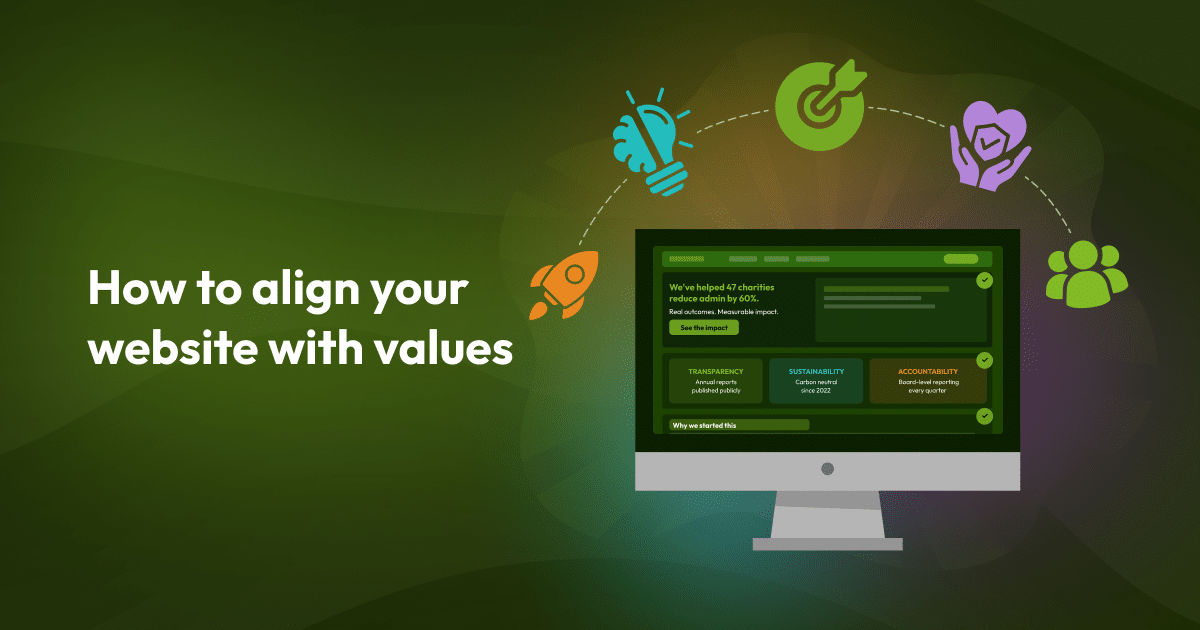


What happens when a website says one thing, but your business does another? A values-led website can help.
Mission-driven organisations attract supporters and donors based on trust. People give time, money, or attention because they believe in the work.
Research from the PTPA found that 81% customers need to trust a brand before they buy from them, and simultaneously, KPMG research states that 54% of consumers say that they would stop buying from a company if they were found to have been misleading in their claims, specifically regarding sustainability.
When a website leads with generic language instead of proof of their impact, that trust is more difficult to build. Supporters can’t tell the difference between an organisation living its mission and just describing it.
This is evident in template-based websites, often built using the same tools and little to no customisation. A generic template looks the same as thousands of other sites, meaning it doesn’t embody your organisation’s values or personality. When visitors land on a template site, they see a stock layout, generic copy placeholders, and standard features. They don’t see you, or what makes your organisation different.
In this post, we’re breaking down how to align your website with your values and the reasons why having a custom website that reflects what you stand for is so important.
What does values-based web design look like?
Start with website design choices that back your stated values instead of contradicting them.
- If transparency is a value, show pricing clearly and real numbers evidencing results.
- If accessibility matters, build to WCAG 2.2 standards and add an accessibility plugin for visitors.
- If sustainability guides decisions, choose sustainable hosting and take actions to reduce page weight through optimising images and reducing unnecessary content (Read this blog post for more on sustainable website development).
When leading a mission-driven organisation, structure the website around what you measure success by, such as the effect on customers, communities served and outcomes that have been delivered.
Consistency matters across every channel your supporters see. Website, email, and social media should tell the same story about what you do and why. When a supporter reads your annual report, then visits your website, then sees your latest campaign email, the message should hold together.

How do you audit your website against your mission?
A simple four-step process works for most organisations.
Step 1: Map your values
Write down the three to five principles your organisation operates by, and the values you work to in all operations. These could be:
- Transparency
- Diversity and Inclusion
- Integrity
- Sustainability
- Innovation
- Collaboration
Determine the most important values, see this page on our website as an example, then write down how these values would be best represented.
Step 2: Find where they show up
Look at your homepage, main services and product pages, and team page. Mark where each value appears in the messaging, the design, and the priorities on the page.
This could be in the form of testimonials, examples of your work, impact reports and accreditation badges, to name a few.
Step 3: Identify the opportunities
Understand where the gaps are in your current website design to make it more values-led, and what could be included to persuade visitors that the business adds more weight to the values they prioritise.
For help identifying these opportunities and adding more value to your current website, let’s chat.
Step 4: Prioritise what your customers will see first
Visual confirmation is a key element of the first impressions your website leaves on a potential customer. With only 5 seconds to leave that impression, your website design not only needs to engage audiences, but also be an accurate representation of who you are straight away.
This means including those values in clear, notable places across the website, instead of reducing them to a page hidden within the menu or buried in the footer.
So, start with your homepage. Does it lead with impact, or with credentials? For most mission-driven organisations, impact should come first.

How your website's functionality reflects your values
It’s not always enough for your words and website design to align with your values. How the site works and what features are included need to reflect them too.
For example, if listening to customers or customer involvement is a value, your website should make contact easy. Include feedback forms, email addresses, and phone numbers prominently. Don’t bury contact information in a footer or behind a contact form that requires five steps.
If accessibility is important to your audience, the site needs to be fully scannable by screen readers, and usable for all visitors.
For businesses prioritising transparency, it’s essential to publish your annual reports, impact data, and financial information publicly.
To ensure innovation and technical accuracy, fixing broken links, preventing slow page load times, and updating outdated information must be done regularly to avoid undermining business claims.
When you audit your website, check not just what you say, but what visitors can actually do.
- Can they contact you easily?
- Can they access information they need?
- Can they give feedback?
- Does the site work smoothly?
- Do all links work?
If any of these fail, your website is contradicting your stated values through functionality.
How do you write about your work without slipping into corporate language?
Write the way your team actually talks about the work they do.
- If your team says “communities” rather than “stakeholders,” use that word on your site.
- If a recent project changed something specific for someone, describe that change directly rather than describing your process in the abstract.
The way text content is written on a website holds plenty of importance for visitors seeking your products or services. With the increased usage of Generative AI for content creation, and a 2025 report from Wondercraft finding that over 80% of creators use AI in their workflow, being unique, relevant and authentic are now the new essentials.
This means that while AI can be used to aid in the content creation process, there is more value in writing text for your website that:
- Is written in your tone of voice
- Uses terminology used by your team, customers and community
- Matches the language used in other marketing activities (for example social media, press releases, email communications etc.)
- Avoids typical AI phrasings, corporate jargon and technical language unfamiliar to customers.
Read this blog post to find out more about using AI tools ethically and purposefully.
Writing with values in mind also applies when describing your team members. A credentials list tells your visitors what someone has done, and a short explanation of how they think about the work tells them what to expect. For example, rather than listing years of experience, explain what that experience taught them and how it shapes their approach now, for the customers’ benefit.

What changes when your website and your mission are aligned?
Website visitors see evidence of your mission in action, and the website and the operations reinforce each other, which builds trust and authenticity that customers can believe in.
The effect reaches further than the homepage:
- Funders or stakeholders ask for evidence, and a site built around outcomes already holds the language and data needed for applications
- Candidates researching a role get an accurate picture before they apply
- Trustees can draw on the same evidence supporters see, keeping the internal and external story consistent
- Customers feel they can trust the brand and are more likely to purchase products or services from you and not a competitor.
With all these changes, your website leaves a positive impact on its visitors and increases the likelihood of conversion.
Ready to close the gap to create a values-led website?
If you’d like a second pair of eyes on where the opportunities might be, we’re happy to talk it through. Beech is experienced in creating values-led website designs that represent businesses accurately.
Keyword Glossary
For more guidance on the terms and phrases used throughout this post, read through our glossary below.
Accessibility plugin: A tool added to a website to support visitors who use assistive technology, used here alongside WCAG 2.2 standards as part of an accessible design approach.
Accreditation badges: Visual marks on a website confirming that a verified standard or certification has been met, used in this post as one way to show where your values show up in practice.
Conversion: The point at which a website visitor completes a desired action, such as a purchase or a donation, referenced here as one outcome of an aligned website alongside trust and reputation.
Credentials list: A summary of someone’s qualifications or experience presented as facts about their background, contrasted in this post with an explanation of how a team member thinks about their work.
Generative AI: Technology that produces text, images, or other content from a prompt, referenced here in the context of writing website copy that stays authentic to your organisation’s voice.
Impact reports: Documents that record and communicate the measurable outcomes of an organisation’s work, listed here as one place your values can appear on your website.
Page weight: The total size of a webpage, including images and code, which affects load time and energy use, referenced here as part of building a sustainable website.
Sustainable hosting: Web hosting powered by renewable energy or run through low-impact data centres, listed here as a values-based choice alongside reducing page weight.
Tone of voice: The consistent style and personality an organisation uses in its written communication, referenced here as the standard to write website copy against instead of generic AI phrasing.
Values-based web design: Building website choices, such as pricing transparency, accessible design, and sustainable hosting, around an organisation’s stated values, the central concept of this post.
Values-led: Describes a website or decision made in direct reference to an organisation’s stated principles, used throughout this post to describe the outcome of the audit process.
WCAG 2.2: The current version of the Web Content Accessibility Guidelines, the recognised standard referenced in this post for building an accessible website.